
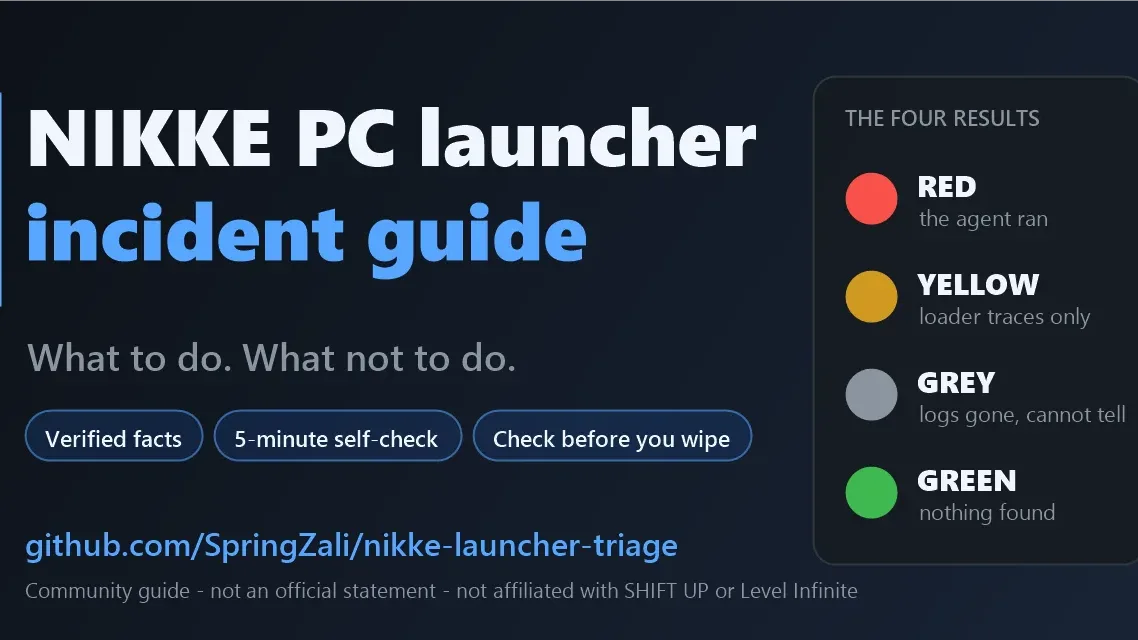
A cyberattack was carried out on the official PC launcher for the Goddess of Victory: NIKKE by attackers who changed JavaScript files on the publisher Level Infinite’s content delivery network (CDN), and this was the result of a supply-chain attack. The game developers made a statement concerning it on November 4, 2026. The downloader that was the launcher’s own signed downloader was hijacked to download a LuaJIT remote access tool, which was approximately 205 KB, and this tool was capable of running commands, taking screenshots, and stealing credentials, API keys, tokens, and crypto wallet data.
GitHub has an attack-chain analysis that indicates how the attacker manipulated JavaScript on the playerinfinite.com CDN and, in that process, made the launcher’s embedded browser load code from a look-alike domain, insightjs.com. This code made use of the launcher’s signed downloader to get the payload and through a COM hijack of CLSID_WindowsParentalControls in the HKCU registry, install a per-victim DLL, so that Chromium-based applications can load the malicious DLL even if the launcher is closed. The paper specifies that twice authentic scripts from CDN had some hijacker codes were implanted on Sep 27th, 2026, between 06:41 and 06:42 GMT. The number of tampered documents was mentioned as four in another GitHub analysis.
Who is affected
The incident affects Windows installations of the NIKKE Global PC launcher, and CyberInsider reports the attack path also reaches users running the launcher through Proton on Linux and Steam Deck. Asia Business Daily, citing a GitHub security report, said users who launched the NIKKE PC launcher after October 24, 2026 are at risk of infection; other analyses describe a risk window from late October onward. Mobile players are not reported as affected.
According to VGTimes, the malware could run arbitrary commands, read and download files, capture screens, and steal browser-saved passwords, Windows Credential Manager data, SSH keys, cloud and AI service tokens, and data from 28 browser-based cryptocurrency wallets. Chosun Biz likewise reported the trojan enabled arbitrary command execution, installation of additional malware, and theft of account information, API keys, authentication tokens and virtual asset wallet data.
VGTimes also reported that the attackers’ server stopped responding on the evening of November 3, 2026, and that one domain linked to the attack was later registered by a third party who posted a warning on it.
Vendor response
The NIKKE operations team said in a November 4 notice that it identified an anomaly indicating launcher script files may have been modified by a third party, and applied an emergency client fix and update around 02:30 that day before beginning a formal assessment of the scope of impact. Inven Global reported that Shift Up CEO Kim Hyung-tae apologized for the incident and said the company is mobilizing all resources to investigate and remediate it.
As of November 4, no verified victim counts have been released, and it is not confirmed whether any information was actually leaked, according to Seoul Economic Daily and Asia Business Daily.
What to do
- Do not open the PC launcher until safety is confirmed, and clear the launcher’s cache.
- Check the launcher’s intl_service debug.log file for the string k2f_chan, which Nikke.gg community guides describe as an indicator that the malicious agent ran.
- Remove the malicious Chrome DLL registered under the PlatformExperienceHelper path in the user’s Local Google User Data directory, per community guidance on Reddit, and run antivirus scans.
- If infected, disconnect the system, change all passwords from a clean device, move cryptocurrency to a new wallet, revoke API tokens and SSH keys, and terminate active sessions.
- Community guides also suggest reinstalling Windows in some cases, because the attacker could have deployed additional malware.
It remains unknown who compromised the CDN, how many users were infected, and whether other Level Infinite titles or services on the same CDN were affected. No CVE identifiers, government advisories, or attribution to a named threat group had been published as of November 4, 2026.